
Delivering four research presentations, UBC CPD members made their mark at the recent Association of Faculties of Medicine of Canada (AFMC) Continuing Professional Development (CPD) Research Symposium on May 22-23.
The annual AFMC CPD Research Symposium provides a supportive space for learning and sharing among the CPD community, an opportunity for research collaboration and dissemination of best practices.
This year, our Strategic Projects and Partnerships, Creative Learning and Rural teams presented four projects, addressing participant retention in rural communities, educational intervention for thyroid testing, the engagement of artificial intelligence-related CPD and empowering rural residents through virtual simulations.
Helping International Medical Graduates (IMGs) in rural communities
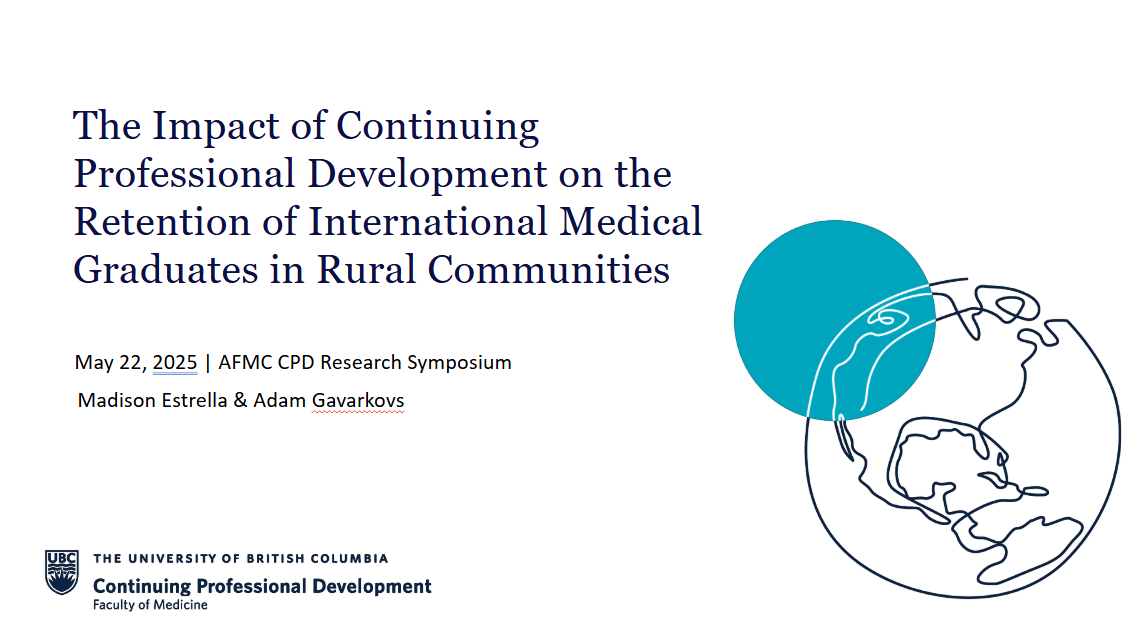
Strategic Projects and Partnerships member Madison Estrella and Research Associate Adam Gavarkovs presented their study on the Impact of Continuing Professional Development (CPD) on the Retention of International Medical Graduates (IMGs) in Rural Communities. This study explores the effect of CPD on IMGs’ decision to remain in rural practice, using registration data from UBC CPD, retention data from the BC Ministry of Health and interviews conducted with IMGs.
“Using a mixed methods approach allows us to learn from both historical participation in CPD and the lived experiences of rural IMGs. This study provides valuable insight into the qualities and types of CPD that are most valued by rural IMGs, which will help us improve our offerings in ways that help physicians feel more confident and supported in their rural practice,” says Madison Estrella, Research and Events Assistant.
| Madison Estrella, BSc, Adam Gavarkovs, PhD, Vivian Lam, BSc, BA, Charlotte Humphries, MA Planning, Stephanie Din, BA, Emily Boardman, MA, Bruce Hobson, MD, Vernon Curran, PhD, Steven Yau, MD, CCFP, CISAM. |
Addressing overuse of thyroid function testing in primary care: a needs assessment and educational intervention
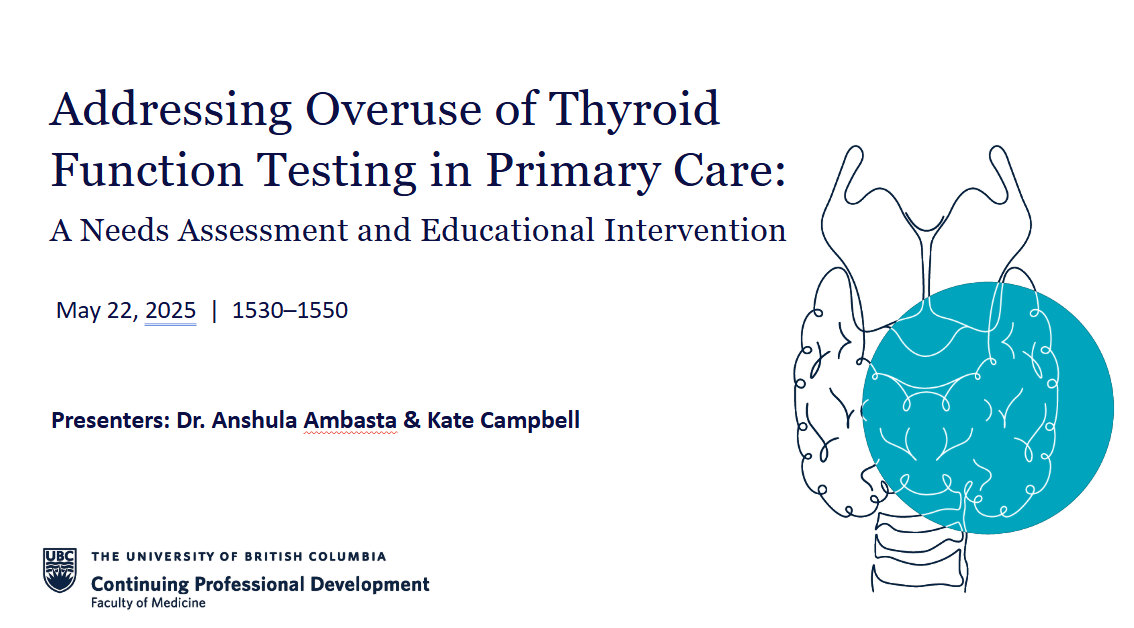
Creative Learning Senior Manager, Kate Campbell and general internal medicine physician Dr. Anshula Ambasta from the Department of Anesthesiology, Pharmacology and Therapeutics presented their ongoing investigation of overdiagnosis and treatment of thyroid disease in primary care — and how online education can bridge these knowledge gaps.
A mixed methods needs assessment helped identify the barriers and facilitators that influence Thyroid Function Test (TFT) practices and inform an educational design for our eLearning course, Navigating Thyroid Testing in Primary Hypothyroidism: Practical Approaches for Health Professionals.
Needs assessment results indicated some health professionals found guidelines conflicting and were uncertain about testing protocols.
"To address these barriers, we incorporated intentional use of different formats for participants to stay engaged and to support a variety of learning types. We evaluated the BC guidelines algorithm and applied interaction and graphic design principles, including simplified language and additional screening step information," says Kate.
Learn more about thyroid testing in primary care in the online module and check out our latest Edubite.
| Anshula Ambasta, MD MPH, Kate Campbell, MSc BSc, Annabel Chapman, PhD, Vernon R Curran, PhD, Vivian Lam, BSc, BA, Caldon Saunders, BA. |
In addition to these works in progress, our teams presented completed projects on the role of artificial intelligence and virtual simulations in continuing professional development.
Assessing physician motivation to engage in continuing professional development on artificial intelligence
Research Associate Adam Gavarkovs presented his recent publication on physicians’ motivation to learn more about artificial intelligence (AI) in medicine.
“This study suggests that physicians are most motivated to learn more about 'what is out there' regarding the AI tools they can use in their practice and the regulatory frameworks that govern such tools,” says Adam. “More broadly, this project demonstrates a new way of assessing health professionals' motivation which can be applied to future needs assessments."
Read the publication in the Journal of Continuing Education in the Health Professions.
| Adam Gavarkovs, PhD, Jaqueline Kueper, PhD, Robert Arntfield, MD, Frank Myslik, MD, Keith Thompson, MD, Bill McCauley, MD MHPE. |
Confidence on call: empowering rural residents with virtual simulations
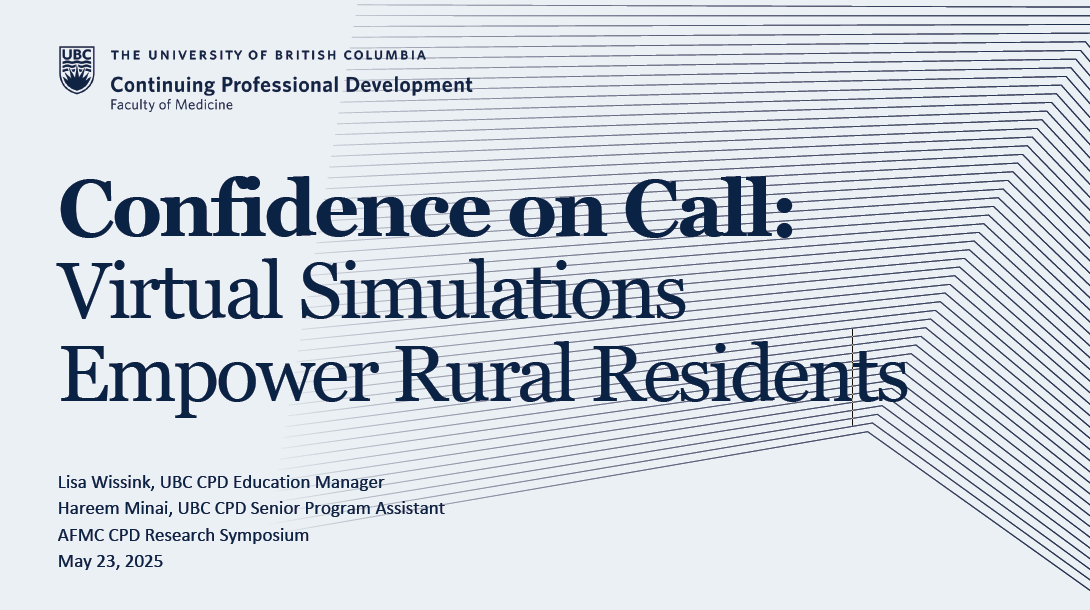
Rural team members, Lisa Wissink and Hareem Minai, shared feedback and results from the past year of the Real-Time Virtual Support (RTVS) Simulation Residency Site Project (RSRSP), which delivered simulation education sessions featuring RUDi (Rural Urgent Doctor in-aid) and CHARLiE (Child Health Advice in Real-Time Electronically) to residency sites across British Columbia.
“Highlighting how experiential learning can improve the uptake of on-demand peer-to-peer virtual resources like RTVS could be an important factor in improving recruitment of rural physicians in the future,” says Lisa. “We look forward to continuing to offer simulation education that integrates RTVS and in turn, supports the retention of physicians in rural and remote communities across the province."
Learn about the Real-Time Virtual Support (RTVS) Simulation program and our collaboration with the Rural Coordination Centre of BC (RCCbc) in the 2025-25 Rural CPD annual report.
| Scot Mountain, FRCPC, Jeanne Macleod, FRCPC, Lisa Wissink, BHSc, Nicole Moon, MHA, Hareem Minai, MPC. |
View the presentation for Confidence on Call: Virtual Simulations Empower Rural Residents.
Shaping a stronger health-care system through medical education
UBC CPD is dedicated to sharing knowledge across the medical education community. Through evidence-based research, we continue to explore the mechanisms that make continuing professional development (CPD) effective for health professionals.
“UBC CPD holds great potential as a living laboratory, where researchers can study the impact of CPD programs and understand why they are effective. We presented four research projects at this year’s symposium, demonstrating our commitment to share findings with the CPD community.”
Read more about our research and evaluation opportunities and connect with us to co-create future CPD.