

On May 21-22, UBC CPD presented at the Association of Faculties of Medicine of Canada (AFMC) Continuing Professional Development (CPD) Research Symposium — an annual meeting that provides space for learning and sharing among the CPD community, an opportunity for research collaboration and to disseminate best practices.
This year, our Strategic Projects and Partnerships, Creative Learning and Rural CPD teams delivered five presentations that brought attention to ongoing and completed research, spanning motivation for CPD in primary care teams, physician wellness awareness through podcasts, and continued learning retention for IMGs and rural physicians.
From Listening to Living: How Podcasts Can Spark Wellness Change
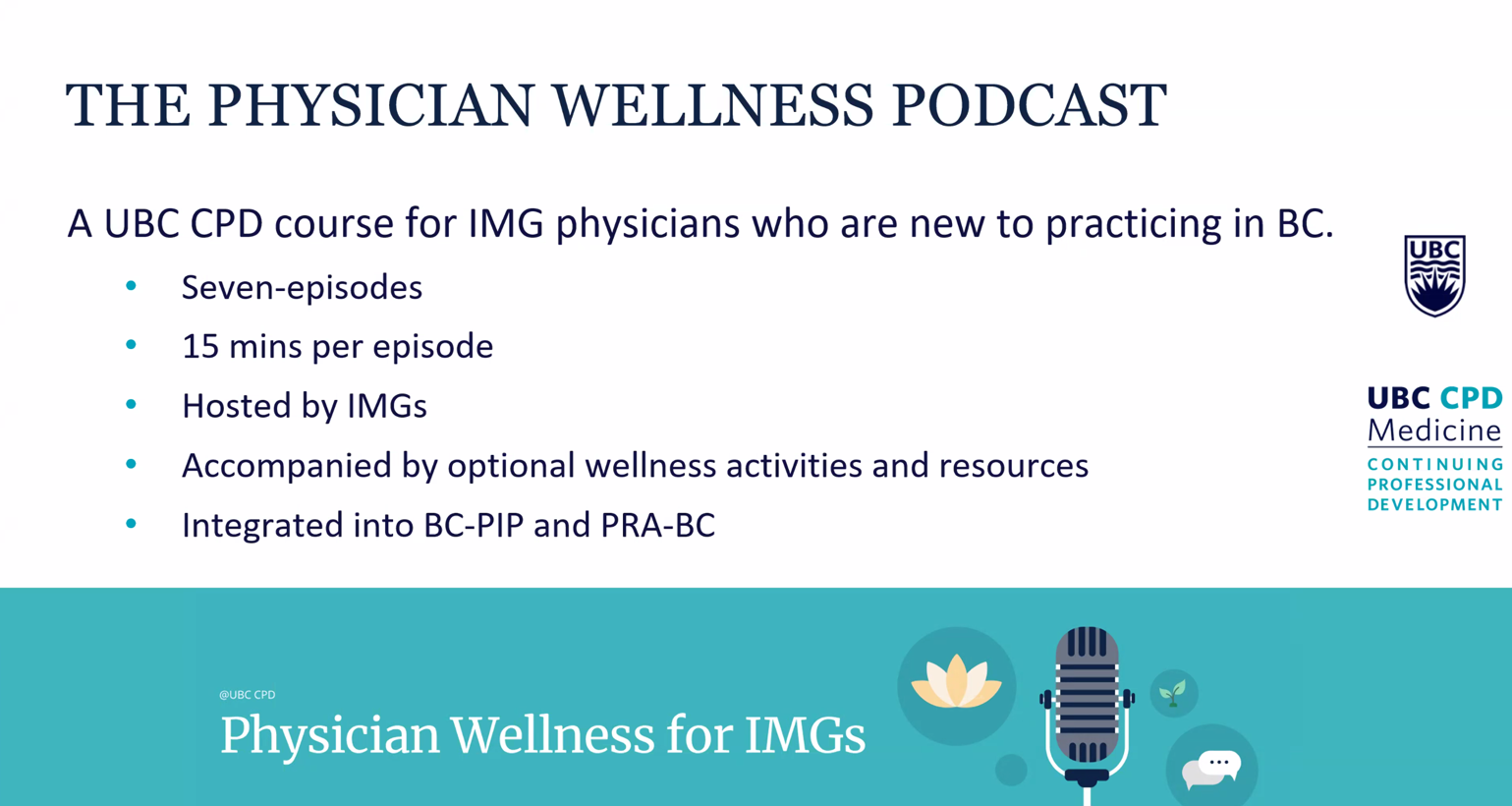
Learning and Curriculum Manager Craig Ferguson highlighted our seven-episode Physician Wellness Podcast, a narrative interview series with and for International Medical Graduates (IMGs) — designed to help new physicians protect their wellness, build supportive practices, and navigate administrative hurdles, isolation and challenges of entering a new health‑care system.
The presentation was co-authored by Research and Program Assistant Madison Estrella and Program Manager Charlotte Humphries.
"Grounding our narrative podcast in the Self-Determination Theory allowed us to create a wellness resource that supports autonomy, competence and relatedness in a way that helps IMG physicians transform wellness advice into personally meaningful practice.”
Why Do Health Professionals Not Start E-Learning Courses After Registering for Them?
Research Associate Adam Gavarkovs presented a study to uncover why health professionals often don’t complete CPD eLearning modules after signing up.
Co-authored by Creative Learning Senior Manager Kate Campbell and collaborators Sharon Ho, Ryan Bridges, Bill McCauley and former CPD Associate Dean Brenna Lynn: the study revealed that health professionals make decisions on completing CPD within the context of their professional and personal demands.
“We learned that simple strategies like reminder emails may have unintended consequences,” says Gavarkovs.
Energizing Team Learning: Exploring Motivation in Primary Care Teams
For primary care teams to remain effective in an ever-changing health-care environment, they must continue to learn, innovate and adapt, yet it’s unknown how motivation for learning develops and evolves in such teams. This study explores primary care teams’ motivation to participate in a facilitated learning session recently delivered by UBC CPD.
Presented by Adam Gavarkovs and co-authored by Rola Ajjawi, Ryan Brydges, Caldon Saunders, Vernon Curran, Brenna Lynn and Rob Petrella.
“This study highlights the complexity of learning in teams,” says Gavarkovs. “Team members’ motivation for learning is determined by their personal desire for improvement and a perception of their colleagues’ investment in learning. This study has important implications for how CPD providers like UBC CPD support learning and innovation at the team level.”
CPD and the Choice to Stay: IMG Perspectives on Rural Retention
Presented by Madison Estrella and co-authored by Adam Gavarkovs and Charlotte Humphries, the team revealed insights from International Medical Graduates (IMGs) on CPD participant retention in rural communities.
“UBC CPD is committed to supporting IMGs transitioning into practice in BC, and this research strengthens our ability to do so effectively,” says Estrella. “By learning directly from rural IMG physicians, this study provides us with a better understanding of the impact of CPD on rural practice and identifies opportunities for us to enhance support for both rural and IMG physicians.”
Rural Physicians’ Motivation to Participate in Peer Coaching

Co-presented by Program Coordinator Ievgeniia Rozhenko and Education Manager Tanya Glafenhein and co-authored by Adam Gavarkovs and Education Manager Emily Boardman, this study drew on data from the Rural CPD Coaching and Mentoring Program (CAMP) to explore motivational dynamics in physician peer coaching. Their goal: to better understand how to support educators to develop programs tailored to the unique needs of rural physicians.
“Coaching is increasingly recognized as a valuable approach in continuing professional development, helping to enhance performance and mitigate burnout,” says Ievgeniia Rozhenko.
Results found that motivation to participate in peer coaching is shaped by multiple aspects of a program and rural physicians' practice context, including:
- perceived gaps between current skills and evolving scope of practice
- professional isolation
- perceived expertise and motivation of a coach
- competing priorities due to professional and personal responsibilities
- experiences during the coaching journey, such as human moments, positive feedback and opportunities to build skills
“This year’s AFMC CPD Symposium reflects our efforts to capture the latent insight that exists at UBC CPD and to promote evidence-based CPD in Canada and beyond. Our current work, which we hope to present at future symposia, continues efforts in the areas of provider well-being, artificial intelligence and team-based care,” shares Adam Gavarkovs.
Read more about our research and evaluation opportunities and connect with us to co-create future CPD.